
Searching the Yuma County Court Docket
Start by figuring out which Yuma County court holds the case. The Arizona Judicial Branch Public Access system is the widest free entry point. It reaches most Arizona courts and takes either a party name or a case number. Treat its results as informational only. The official record stays with the court itself. The weekly refresh also means recent activity can lag behind what the court shows. A common name can flood you with matches. Narrow the search to the Yuma County court on your paperwork.
A good Yuma County court docket search moves from a broad index toward the office that actually keeps the record. Local ordinance charges never show up in Public Access. Probate, most juvenile cases, mental-health matters, protective orders, and sealed files can be absent too. So a blank result means try another channel. It does not mean no case exists.
- Identify whether the matter belongs to Superior, Justice, or Municipal Court.
- Complete the Public Access verification and choose party-name or case-number search.
- Narrow the result by the correct Yuma County court and case type.
- Read the newest case events and future hearings, then verify time and division.
- Ask the court that owns the file for a document or certified copy.
The official statewide search screen is where a Yuma County court docket lookup begins, with its verification step and case-search entry point.
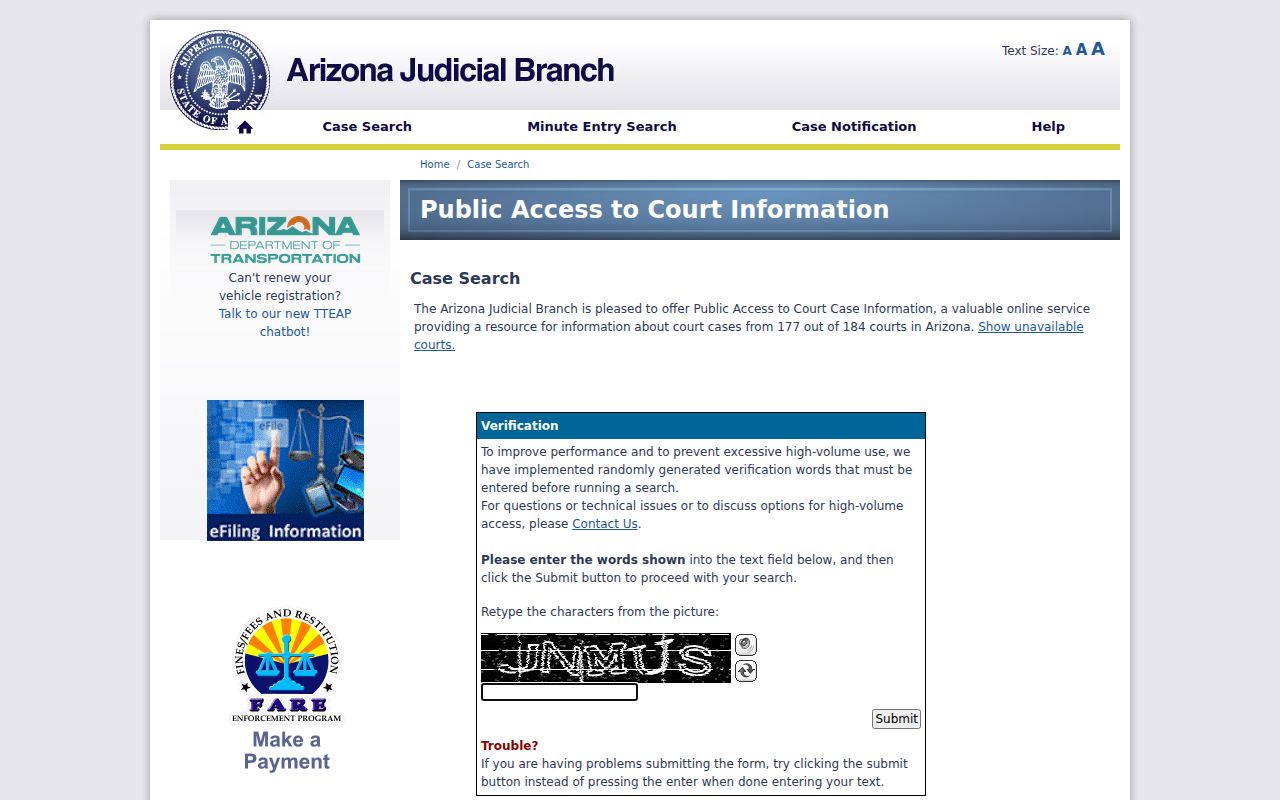
Think of the screen as a discovery tool. For a complete or certified record, the originating Yuma County court is still the source.
Yuma County Docket Prefixes
Four prefixes work as a routing key. S1400 marks the Superior Court in Yuma County. J1401 belongs to Yuma Justice Court. J1402 goes to South County Justice Court, and J1403 to Wellton Justice Court. Checking the prefix first can save you a call to the wrong Yuma County records counter, since two courts sometimes share a town or address.
Prefixes help when a case moves as well. An appeal from a lower court can open a new Superior Court number while older entries sit in the original Yuma County court docket. If a notice or citation lists both numbers, search both. Municipal matters may follow other formats, so trust the legal court name printed on the notice over any guess based on geography.
Routing key: A Yuma County prefix identifies the custodian, but it does not prove that every event or image is available online.
Inside a Yuma County Court Docket
Arizona systems often label the public chronology "case information" or "case events." Those fields are, in practice, the Yuma County court docket or register of actions. The header gives you the court, number, filing date, case type, and status. Below it come party roles, charges or civil claims, dated events, hearings, and outcome fields. Some listed events have no image online.
Read the record in layers. Confirm the Yuma County court and case number first. Next, tell a filing label apart from the document actually filed. Then find the newest future setting. Also note any later reset. Last, take the outcome from a disposition field or final order. Do not read it off a hearing title.
| Case number | The court-assigned identifier and, often, a Yuma County routing prefix. |
|---|---|
| Parties | Public names and their roles, with counsel where the system displays it. |
| Case events | Dated filings, orders, hearings, payments, and other docket activity. |
| Hearing setting | Date, time, type, division, judge, or courtroom, subject to confirmation. |
| Disposition | The recorded result of a charge, count, claim, or case. |
| Document status | Whether an image is available through eAccess or must be requested. |
Yuma County Docket Search Delays
Public Access refreshes each Friday with data through the preceding Wednesday. Several days can pass, then, between a live Yuma County court event and its statewide appearance. The daily county calendars cut the other way. They may be newer. But both the Superior Court and Precinct One pages warn that their listings are not official and may omit changes.
When timing matters, chain your checks together. Start with the signed notice or citation. Then review the most recent Yuma County case events. Check the correct daily calendar. Call the assigned division or the court printed on the document after that. The Superior Court division is the best source for its own setting. Yuma Justice Court answers at 928-817-4100, South County at 928-314-5100, and Wellton at 928-785-3321. For City of Yuma case-status and date questions, call its Municipal Court at 928-373-4800.
Note: Missing a Yuma County online calendar listing does not excuse a failure to appear. Only direct court confirmation controls.
Courts That Keep Dockets in Yuma County
No single clerk holds every local case in Yuma County. The Clerk of the Superior Court keeps the felony, major civil, domestic-relations, probate, juvenile, appeal, and post-conviction records filed there. Each of the three Justice Courts maintains its own limited civil, eviction, small-claims, traffic, misdemeanor, and preliminary-felony files. Municipal Courts handle city traffic, misdemeanor, and ordinance cases.
The civil amount is a handy dividing line. Yuma County Justice Courts cover many civil matters through $10,000. Larger general civil cases go to Superior Court. Felony trials belong in Superior Court. A Justice Court may still hold a preliminary proceeding. Municipal appeals can reach Superior Court. Felony and private civil cases, though, never start in city court and "roll up."
| Court | Yuma County docket slice | Record route |
|---|---|---|
| Superior Court | Felony, major civil, family, probate, juvenile, appeals | Public Access, eAccess, Superior Court Clerk |
| Justice Courts | Limited civil, eviction, small claims, traffic, misdemeanor | Public Access and the named precinct court |
| Municipal Courts | City traffic, ordinance, and misdemeanor matters | City court telephone, counter, or records request |
Yuma County Filing Versus Access
eFileAZ and Arizona eAccess do different jobs. eFileAZ delivers filings to a court; it is not a complete anonymous Yuma County court docket. Arizona eAccess is a registered document service. It serves qualifying open Superior Court civil and criminal cases filed on or after July 1, 2010. Public Access stays the free case-information index.
The gap grew once eFileAZ reached all three Yuma County Justice Courts in September 2025 for civil, eviction, and small-claims filings. Attorney use became mandatory on February 1, 2026. A filer may see unrestricted documents after clerk acceptance, but that view does not turn the filing system into a public search portal. Superior Court e-filing coverage also varies by case type.
The official eFileAZ landing page shows the filing channel used for covered Yuma County cases.
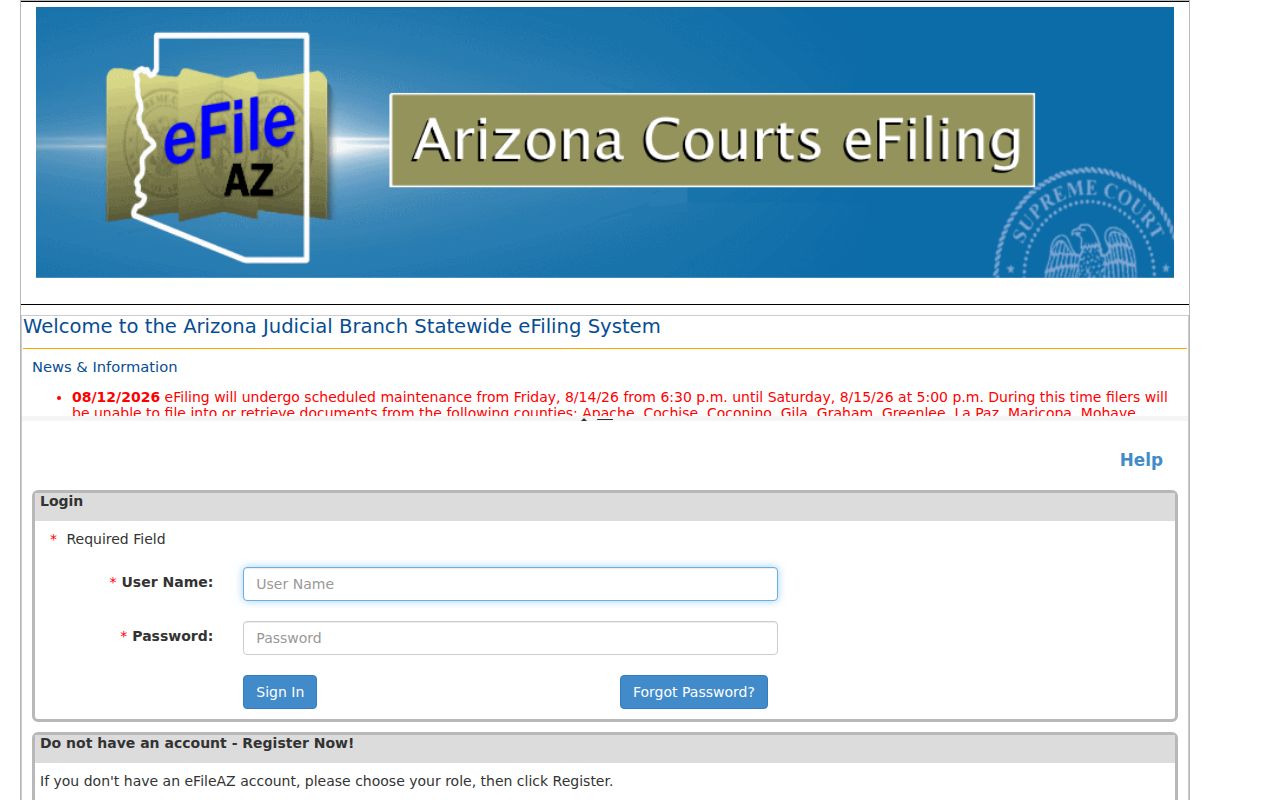
Anyone after Yuma County case events should use Public Access, eAccess, or the custodian. Do not start a filing workflow.
How to Find Court Dates and Settings
A Yuma County court date can surface in three places. Case events, a filed notice, and the daily calendar each show it a bit differently. The filed order or notice records what the court actually directed. A case-event entry is a searchable summary of that action. The county calendar is a convenience view only. It warns users to confirm any changes. For channel-by-channel steps, the Yuma County Court Dates page walks through Superior, Justice, municipal, and remote-setting checks.
Read settings from newest to oldest. A "reset" or "continued" entry keeps the prior date in the Yuma County court docket as history. A later setting becomes the controlling one. Also remember that hearing type is not hearing result. An arraignment, status conference, motion hearing, settlement conference, trial, or sentencing label describes the planned event. It does not tell you what happened there.
- Setting
- A scheduled court event with a date, time, and hearing type.
- Reset
- A later date that replaces an earlier active setting.
- Continuance
- A court-approved delay that moves a hearing or trial.
- Disposition
- The recorded outcome, which is separate from the setting label.
Yuma County Docket Document Layers
A free Yuma County court docket is only an index. It can show that a motion, order, judgment, or hearing exists. It does not give you the document's text. Arizona eAccess fills that gap. It sells Superior Court civil and criminal images to registered users. The first-page preview carries an UNOFFICIAL watermark. After purchase, download the files within 24 hours.
Certification adds a third layer. A browser print is not certified. An eAccess image costs $10 under the cited order. Electronic certification is $39 with a 180-day verification window. The Superior Court Clerk publishes plain copies at $0.50 per page. Clerk certification is $35. A receiving office may still want a raised seal. Confirm the form of proof before you buy anything.
The Arizona eAccess coverage notice shows why Yuma County document retrieval works differently. It is not the same as a free docket lookup.
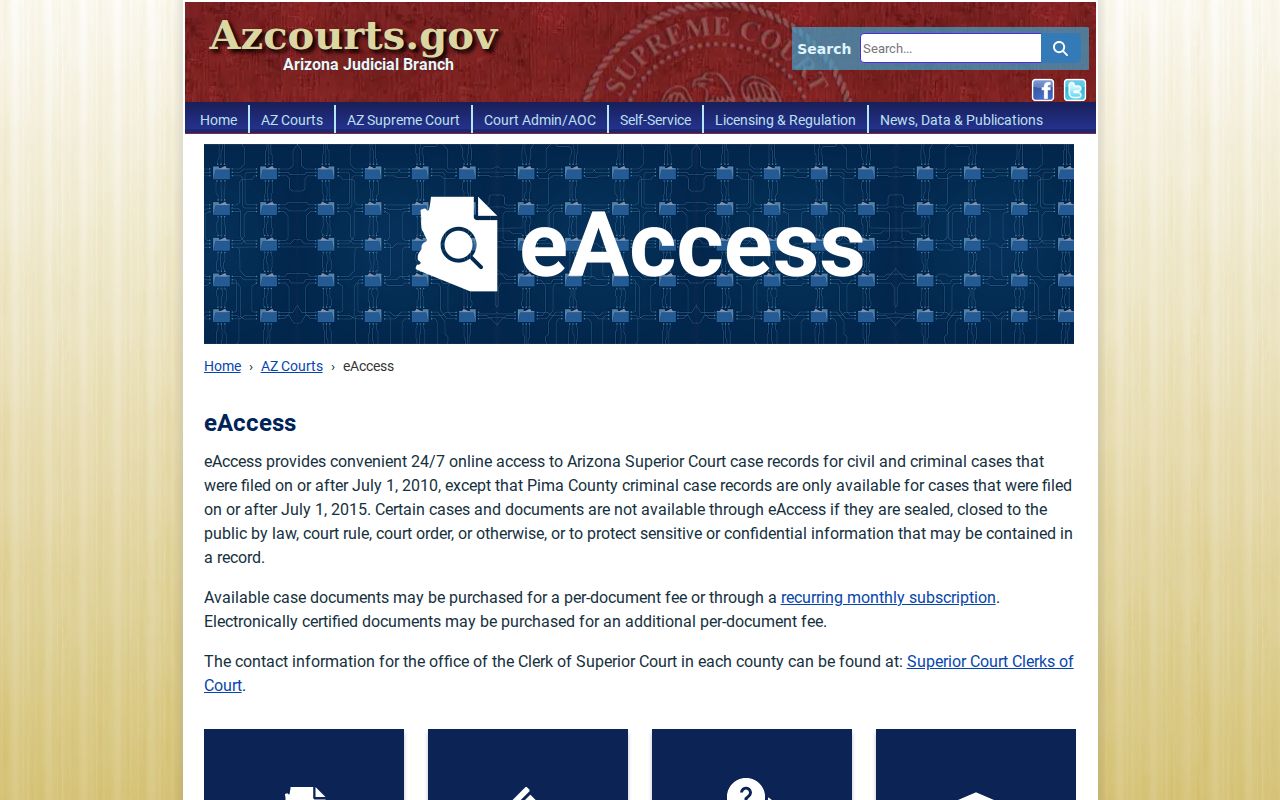
When eAccess says a document is unavailable online, ask the Yuma County clerk. That message alone does not mean the filing is sealed.
Public Access to Court Dockets
Arizona handles judicial records under a court-specific access framework. Openness is the starting point. But confidentiality, sealing, and administrative limits can each block an online Yuma County result. Make any request precise: state the court, the case number, the date range, and the document you want. Certification must come from the office that actually holds the Yuma County court record.
Key Rules:
Arizona Supreme Court Rule 123 governs access to judicial records across Arizona courts.
ARS §39-121 states the general public-record inspection principle, while Rule 123 more specifically controls court records.
ARS §13-911 authorizes sealing of qualifying criminal case records through the proper court process.
Sealed cases, most juvenile cases, mental-health matters, protective orders, probate, victim or witness data, and local ordinance charges all fall outside the statewide search. So an absent Yuma County docket can simply reflect a spelling issue, wrong court, delayed update, retention rule, or older archive. Check those causes before drawing any conclusion.
Yuma County Older Docket Images
The Yuma Courts 2026–2028 technology plan identifies a proprietary BMI store holding pre-2005 historic case-file images. It calls for that store's replacement. That archive helps explain why an older Yuma County court docket may show an event index. It may show no convenient image. It is a technology boundary. It is not proof the record is sealed or destroyed.
For an older file, give the Clerk the court, the approximate year, a party or case number, and the exact document title. Details matter because Superior Court research runs $35 per year or source, plus copy terms. The Yuma County Justice Center Law Library offers public computers and WestlawNext. Self-service prints run $0.20 per page. Those prints aid research but are not clerk certification.
Yuma Municipal Court has its own retention warning. It states that criminal-offense records may be unavailable more than five years after final adjudication and sentence completion. Do not treat that municipal rule as the retention rule for every Yuma County court.
Docket Records at the Clerk's Office
Elected Clerk Lynn Fazz and Chief Deputy Bobbie Jo Daily oversee the official Superior Court record. The Yuma County Clerk receives filings and enters case activity. It supplies plain, certified, exemplified, and authenticated copies. Call 928-817-4234 for records and certifications. Criminal questions go to 928-817-4236, civil questions to 928-817-4226, domestic relations to 928-817-4231, and appeals or post-conviction matters to 928-817-4237.
The public counter sits on the first floor of the Yuma County Justice Center. It runs from 8:00 a.m. to 5:00 p.m. on weekdays except holidays. Mail, fax, and email routes appear on the official Clerk contact page. The Clerk offers no dedicated general Superior Court request form. It promises no turnaround. Call before sending a complex request. A Justice or municipal record must go to that court's own keeper.
Clerk of the Superior Court
250 West 2nd Street, first floor
Yuma, AZ 85364
928-817-4234
Yuma County Docket Court Scale
Yuma County counted 203,881 residents in the 2020 Census and an estimated 224,449 on July 1, 2025. The court structure underneath includes seven Superior Court judges, three Justice Court precincts, and four incorporated places with municipal courts. Those numbers explain why one Yuma County name search can cross several distinct record keepers.
The county's adult-probation report listed 1,059 active standard cases in August 2025. That is a probation workload figure, not a count of Yuma County court docket filings. Labels matter here, because filing volume, calendar settings, probation cases, and population each measure a different part of the court system.
Yuma County Court Dockets by City
Four incorporated places make up Yuma County in the 2020 Census. They are Yuma, San Luis, Somerton, and Wellton. Each one runs a municipal court. It hears its own traffic tickets, ordinance violations, and misdemeanors. Big unincorporated communities get no stand-in here. They simply do not operate city courts. When you pull a city citation, trust the legal court printed on it. Do not trust the closest town name.
Municipal dockets stay separate from the three Yuma County Justice Court records. That matters most in San Luis. South County Justice Court and San Luis Municipal Court keep different dockets there. Wellton adds its own twist: the Justice and Municipal Courts there share a building, a phone number, and a judicial officer. Even so, they remain separate custodians of their own court records.
Yuma Docket Search
95,548 in 2020 · city traffic, ordinance, and misdemeanor cases
San Luis Docket Search
35,257 in 2020 · border-city Municipal Court records
Somerton Docket Search
14,197 in 2020 · municipal case events and city citations
Wellton Docket Search
2,375 in 2020 · separate town and precinct court dockets
Yuma County Specialty Docket Boundaries
Yuma County runs several problem-solving dockets. Their names can surface inside a public criminal case. Adult Drug Court dates to 1998. It lasts at least 18 months. It leans on regular court appearances, testing, treatment, and support. Track I sits in front of a conviction and can end in dismissal. Track II comes after conviction, while the person is on probation. The public index can still show events from the underlying CR case. Treatment details are a different matter, so never presume those are open too.
Veterans Treatment Court first met in 2021. Mental Health Court takes qualifying probationers, though separate mental-health cases stay out of Public Access. Juvenile Drug Court connects to juvenile matters. Those are also generally missing from the statewide case lookup. If a Yuma County program name shows up in a docket event, treat it as part of the assigned case. Ask the holding court what is open. A setting label alone proves nothing about confidential facts.
Where do appeals fit? Superior Court appeals go to the Arizona Court of Appeals, Division One. A case appealed from municipal or Justice Court lands in Superior Court first under Arizona law, which leaves a distinct trail across the receiving court's docket.
Map and Directions to the Yuma County Justice Center
Superior Court felony, major civil, domestic-relations, probate, juvenile, appeal, and post-conviction files are kept at the Yuma County Justice Center, 250 West 2nd Street, in Yuma. The Clerk of the Superior Court's public counter is on the first floor, and Superior Court administration operates from the same building. The Justice Center's Law Library offers public computers, WestlawNext, and self-service copies at $0.20 per page when a file needs on-site checking beyond the web portal.
Clerk of the Superior Court
250 West 2nd Street, first floor
Yuma, AZ 85364
928-817-4234
Monday through Friday, 8:00 a.m. to 5:00 p.m., except holidays
Some county pages print ZIP 85634 for this address, which appears to be a typo; other official court listings use 85364. Security-screening and device rules for the Justice Center were not published in the official sources reviewed, so confirming with court administration at 928-817-4088 before a visit is the safest approach.