
Searching Yuma County Criminal Dockets
The free Arizona Public Access to Court Information system is the natural first stop for a Yuma County criminal docket search. Most Arizona courts are in it. You can look up a case by number or by party name. Pick the Yuma County court when you can. Case-number prefixes help route a result. The code S1400 points to Superior Court. The codes J1401, J1402, and J1403 identify the Yuma, South County, and Wellton Justice Courts. One caution: the statewide result is informational, not the official Yuma County court record.
One channel is not always enough. Public Access refreshes weekly on Friday and reflects data through the prior Wednesday. For qualifying Superior Court civil and criminal cases filed on or after July 1, 2010, registered Arizona eAccess users can search events and buy available document images. A missing or older Superior Court entry has another route. Call the Criminal Clerk at 928-817-4236. Records and certifications are handled at 928-817-4234. A misdemeanor, traffic, or ordinance file stays with the exact court that heard it. It always belongs to that Justice or Municipal Court.
- Read any notice, release paper, or prior order for the court name and case number.
- Pass the Public Access verification screen, choose the correct Yuma County court, and search by full case number or party name.
- Match the court, case title, filing date, and case type before opening the result.
- Read charges count by count, then review events and the newest future hearing.
- Ask the proper clerk for a filed document, current setting, or certified copy when the online record is not enough.
Yuma County Criminal eAccess Fields
Arizona eAccess is a registered Yuma County document route. It is not the free statewide lookup, and it is not the filing system. Try a full or partial criminal number like CR202301234. A case title works as well, or a participant name, business name, judicial officer, or CR case type. Case and Event Search adds date and text filters. Pick Yuma County Superior Court to screen unrelated matches.
The event field has real power. It can find event text such as a motion to continue or an order granting relief. Boolean AND, OR, and NOT controls refine participant searches. Results can be sorted. An account user can also open Case Details to see whether a filing carries a document icon. An export requires a CAPTCHA step, and the system caps it. Handy as they are, these tools fit a known Yuma County criminal docket; they do not turn eAccess into a full search of Justice Court, Municipal Court, juvenile, probate, or sealed material.
| Field | Best use | Key limit |
|---|---|---|
| Case number | Full or partial CR number | Confirm the selected court |
| Participant | First, middle, last, or business name | Common names need more filters |
| Event description | Find a motion, order, or other event | The event title is not the document text |
| Date range | Narrow a long event history | Any Time is the default |
| Judicial officer | Check an assigned judge | Assignments can change |
Inside a Yuma County Criminal Docket
Every Yuma County criminal docket opens with case identity. You get the number, title, filing date, category, status, court location, and current judicial officer. Party and attorney details follow when public. The charge block is the heart of it. Each count may carry a statute, description, classification, disposition, and disposition date. Event and hearing blocks then line up filings, orders, court dates, courtroom data, hearing types, and results in time order.
Read each part for its own job. A filed charge is an allegation. The disposition field records the later result. A hearing label shows what was set, not necessarily what occurred. A document icon means eAccess may offer the image. The phrase "Document Not Available Online" only says the image cannot be bought there. It does not prove the Yuma County criminal docket is sealed, nor that the event never occurred.
| Case number | The court identifier, often including a CR designation for a Superior Court criminal matter. |
|---|---|
| Charge information | The cited law, offense text, classification, count, and recorded outcome when one has been entered. |
| Case events | Dated filings, motions, orders, and other acts in the criminal chronology. |
| Hearings | The date, courtroom, type, and result when the result has been posted. |
| Documents | An available image icon or a notice that the filing is not offered online. |
Yuma County Criminal Disposition Pitfalls
A blank disposition is not a dismissal. It often just means no result has been entered yet for that charge. One dismissed count does not end the rest. To read a Yuma County criminal docket correctly, weigh each charge's disposition against the latest event and any final order. Never infer an outcome from an old hearing label, an empty result field, or one isolated event.
Resets deserve the same caution. An earlier hearing stays in the historical case events even after a new date is set. Find the newest future hearing. Then confirm it with the assigned division or court. If the outcome matters, get the actual order from eAccess or the clerk. A watermarked first-page preview is marked unofficial. An electronic certification can be checked for 180 days, yet a receiving office may still demand a raised seal from the Clerk of the Superior Court.
Arizona publishes no verified Yuma-specific glossary of criminal disposition codes. Confirm unfamiliar shorthand with the court.
How a Criminal Case Moves
A Yuma County felony in Superior Court can begin with a complaint, information, or indictment. Initial appearance and arraignment come next. Those events cover early status, rights, plea, release, and future settings. Disclosure, motions, and pretrial conferences then build the Yuma County record. A plea or trial follows. Sentencing follows when required. An appeal or post-conviction filing can add events. It can also create a linked proceeding. The case may also move courts.
Yuma County criminal docket flow: Filing → Arraignment → Pretrial → Plea or Trial → Disposition → Sentencing.
Treat this flow as a rough map. Not every criminal case hits every stage, and few move at one steady pace. Justice Courts run preliminary felony proceedings, not felony trials. Misdemeanor charges in Municipal and Justice Court often take a shorter route. If a lower-court case gets appealed, pull both files. Search the original case number and the new Superior Court number, since each docket may hold only part of the history.
Yuma County Criminal Courts Compared
Where does a Yuma County criminal docket live? It depends on the charge level and where the case started. Felonies belong mainly to the Superior Court in Yuma County. The Yuma, South County, and Wellton Justice Courts each handle misdemeanors within their limits. They also take criminal traffic and the early stages of a felony. City ordinance, misdemeanor, and traffic matters inside city limits go to the Municipal Courts. One catch: local ordinance charges never appear in statewide Public Access. Those searches must start with the city court itself.
| Court level | Criminal docket role | Record route |
|---|---|---|
| Superior Court | Felony cases, some concurrent misdemeanor matters, appeals, and post-conviction work | Public Access, eAccess, then Criminal Clerk |
| Justice Court | Misdemeanors, criminal traffic, and preliminary felony proceedings | Public Access and the named precinct court |
| Municipal Court | City ordinance, city misdemeanor, and city traffic cases | The city court, especially for ordinance charges |
Courts That Hold Criminal Dockets
The Clerk of the Superior Court keeps the official felony file. The same office records Superior Court case activity. That office does not hold every Yuma County criminal docket. Each Justice and Municipal Court keeps its own limited-jurisdiction record. For Superior Court criminal matters, call 928-817-4236. Appeals and post-conviction questions use 928-817-4237, and copies or certifications use 928-817-4234.
For a Justice Court file, open the official Yuma County Justice Court locations and match the case prefix. Then call the precinct: Yuma Justice Court at 928-817-4100, South County at 928-314-5100, or Wellton at 928-785-3321. City matters go to the named Municipal Court. This court-by-court check matters most when a name search comes back empty. The cause could be a spelling error or a wrong court filter. It could also be an excluded ordinance case, delayed data, an older file, retention rules, or a lawful seal.
Yuma County Criminal Calendar Scale
Prosecution numbers explain why one Yuma County criminal docket can hold many settings. The Yuma County Attorney reported a heavy workload for 2022. Its Criminal Division reviewed 2,484 felony and misdemeanor investigations that year. It filed cases against 1,588 felony defendants. The office also attended two grand juries. It sat two days each week while managing long weekly criminal calendars. These are workload measures for the County Attorney, not a tally of court filings or open cases.
The figures give context for a Yuma County criminal docket search. No single case follows the average. A packed weekly calendar also raises the odds that a stale setting will mislead you. Check the newest event first. Then confirm the date with the court, especially after a continuance or reassignment.
Sealed Dockets and Public Access
Arizona Supreme Court Rule 123 governs access to judicial records in Arizona courts. The free statewide search leaves out sealed matters. It also excludes protective-order, mental-health, victim and witness, most juvenile, probate, and local-ordinance information. Even an open event may lack a public image. For official proof, go to the court that holds the record. Don't rely on a browser print.
Arizona Revised Statutes §13-911 lets a qualifying person petition to seal criminal case records in each court holding a relevant case. Sealing removes public access. The person, counsel of record, qualifying victims, courts, clerks, and specified justice agencies keep authorized access. A failed name search proves nothing about sealing. Check spelling and the court first, then ask whether a public record can be disclosed. The Arizona Judicial Branch posts the official sealing forms and process.
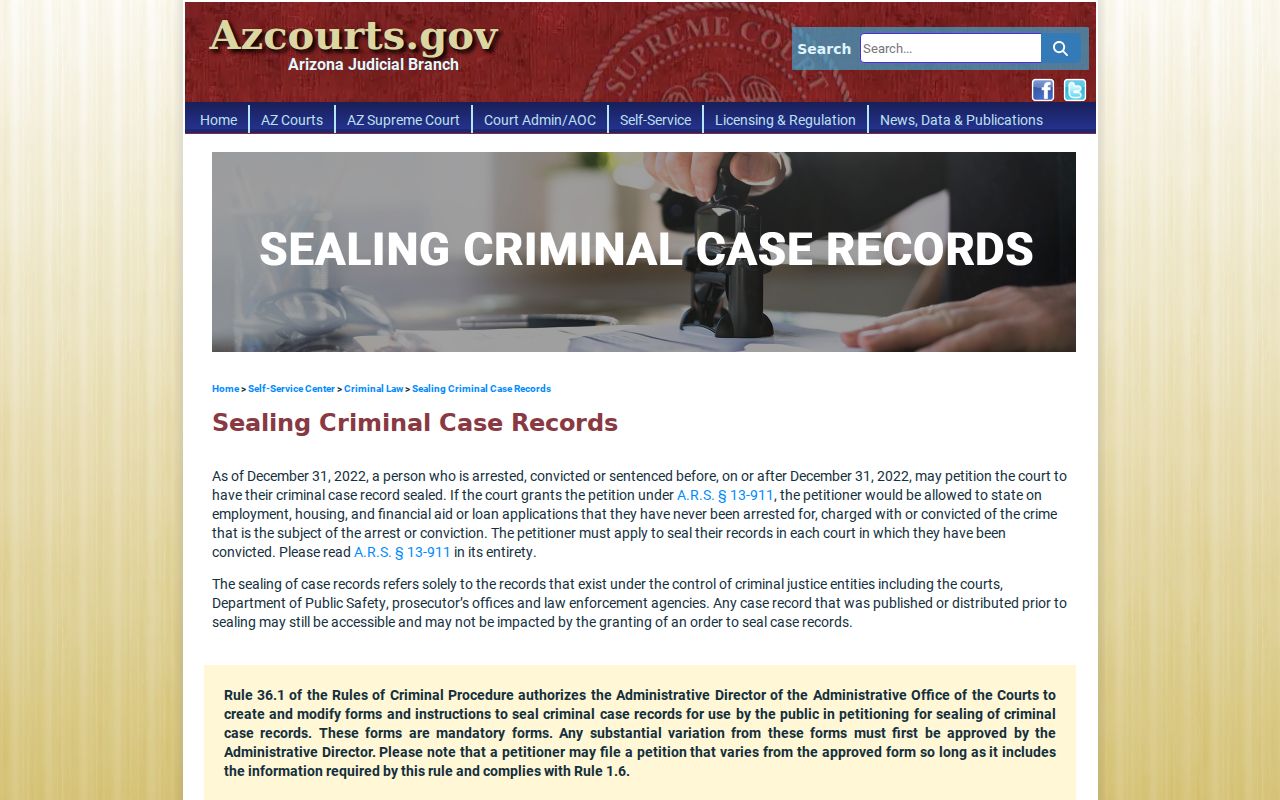
That page lays out the statewide forms and eligibility rules. The petition itself goes to the court that controls the Yuma County criminal record.
Key access rules:
Arizona Supreme Court Rule 123 sets the judicial-record access framework and its confidential categories.
ARS §13-911 governs qualifying petitions to seal criminal case records and continued authorized access.
ARS §39-121 states the general public-record inspection rule, while judicial records use the more specific Rule 123 process.
Older Yuma County Criminal Docket Files
Arizona eAccess covers open Superior Court civil and criminal cases filed from July 1, 2010 forward. Even so, a covered Yuma County criminal docket may not show every image. Older and non-digitized records often need clerk help. The county's court technology plan lists a proprietary BMI store holding case-file images from before 2005. The plan also proposes replacing it. That history explains some retrieval friction. It does not mean an old file was lost or sealed.
Gather the court name, an approximate year, a party name, the case number, and an exact document title or event date before you call. The Superior Court publishes a $35 research charge per year and source. Copy costs apply when they apply. Public computers at the Justice Center Law Library help with digital research. But the Clerk counter supplies the official file and certification. For the broader lookup path, see the Yuma County Case Lookup process before asking for a specific criminal filing.
Note: Give the clerk a narrow year range and a document name. That cuts down avoidable research across older Yuma County criminal docket sources.